SOC 2 Penetration Testing: What Your Auditor Will Ask For, and How to Scope It
The Trust Services Criteria do not make a pentest mandatory, and your auditor decides what evidence is enough. A pentest is still one of the most direct kinds of evidence for the monitoring criterion, CC4.1. Here is how to scope it against your system description, time it against a Type 1 date or a Type 2 period, and get a report and retest your auditor can use.
IrenicTech · · 11 min read
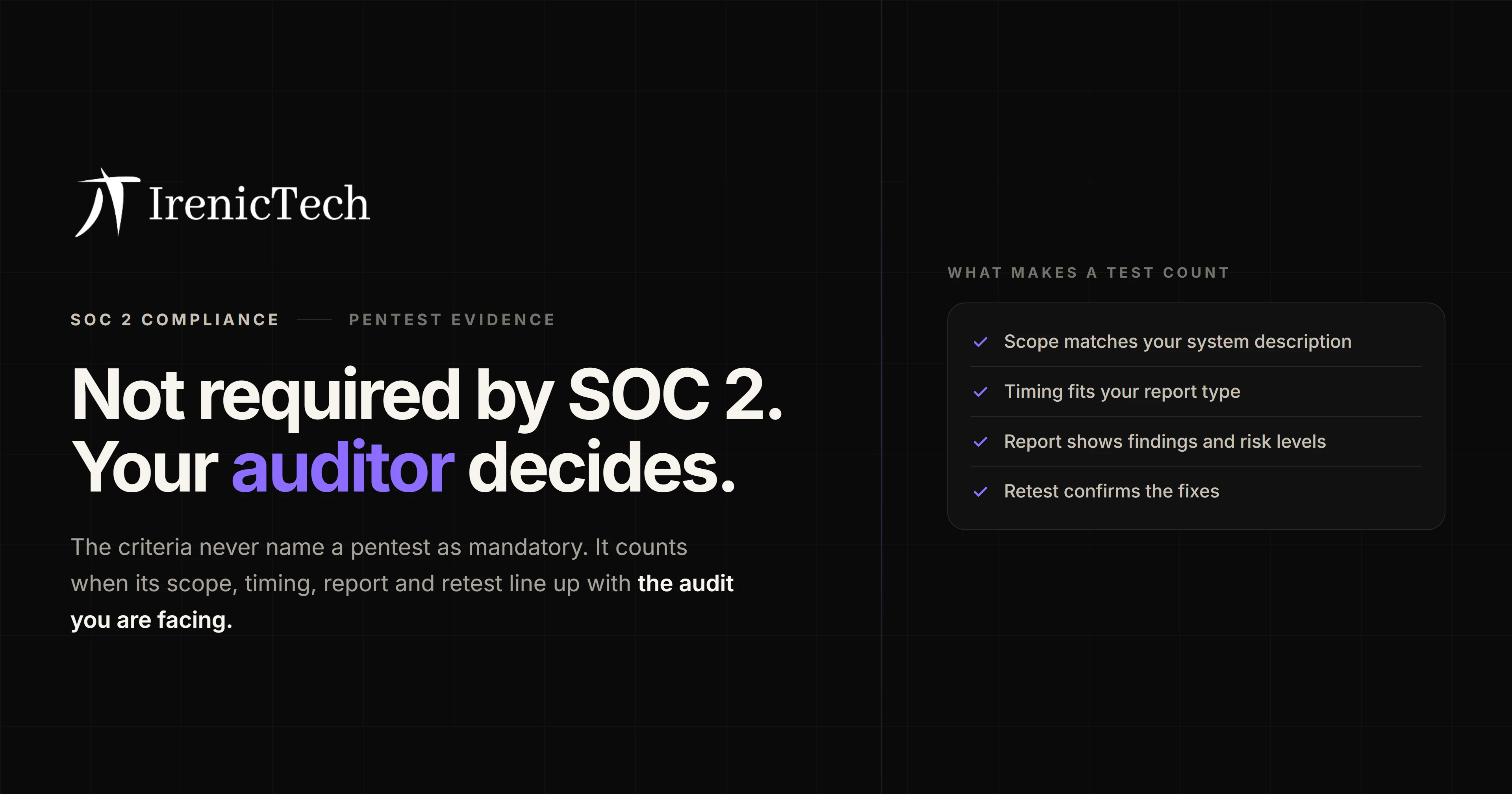
SOC 2 penetration testing is not written into the Trust Services Criteria as a requirement. No criterion names a pentest as a mandatory control, and your auditor, not a checklist, decides what evidence is enough.
That is not the same as "you can skip it". A pentest is one of the most direct kinds of evidence for CC4.1, the criterion on checking that your controls actually work. If you need a test this month, here is how our VAPT engagements are scoped and reported.
This guide covers what the criteria say, then the four decisions that make a pentest count: scope, timing, the report and retest, and who runs it.
Does SOC 2 require penetration testing?
SOC 2 does not require penetration testing by name. The Trust Services Criteria describe what your controls must achieve, not which test proves it, and CPA firms that perform SOC 2 audits say so plainly.
An audit partner at Linford & Company, a CPA firm, wrote in 2021 that a pentest is not needed to meet the criteria, and neither is a vulnerability scan. Mike DeKock, a CPA, goes further in a 2024 article republished by the Cloud Security Alliance: SOC 2 sets no explicit requirement for a pentest, or for any specific control. Drata, a compliance software vendor, calls a pentest "technically not a requirement".
The catch is the word "technically". As risk3sixty, a security and CPA firm, put it in 2019, it is up to each audit firm to decide, and auditors differ. In its view, scans were in effect mandatory for CC7.1, while a pentest was not strictly needed for CC4.1 if you ran some other periodic security assessment.
So the honest answer is this. You can pass without a pentest if you show the auditor another separate evaluation they accept. A pentest is a straightforward way to do that.
One date to know. In October 2026 the AICPA proposed an update to the criteria, published as an exposure draft. If approved, it would apply to engagements beginning on or after 31 December 2027, with early adoption permitted, and comments are open until 15 January 2027. The announcement says nothing about penetration testing, and audits today run on the current criteria.
SOC 2 penetration testing requirements: what the criteria say
The SOC 2 penetration testing requirements come down to two criteria, CC4.1 and CC7.1, and neither makes a pentest mandatory. The wording below is the criteria text as CPA audit firms quote it, and the firm is named each time.
CC4.1 is the monitoring criterion, built on COSO Principle 16. As risk3sixty quotes it, the entity runs "ongoing and/or separate evaluations" to confirm that its controls are present and working.
The points of focus under CC4.1 give examples of what those evaluations can be. Linford & Company's 2023 summary lists, among others, internal audit assessments, vulnerability scans, security assessments, penetration testing and third-party assessments. A pentest is one option on that list.
Points of focus are guidance, not a checklist. Linford & Company says an entity does not necessarily need a control for each one, as long as its controls meet the requirement the points illustrate. CliftonLarsonAllen (CLA), another CPA firm, cites AICPA guidance at TSP 100.04 saying that an assessment of whether all points of focus were addressed is not required.
CC7.1 covers system operations, and it is where vulnerability scanning sits. As risk3sixty and Linford & Company quoted it in 2019 and 2021, its point of focus describes scans that look for vulnerabilities or misconfigurations, run on a regular basis and after significant changes, with what they find fixed in good time.
| Criterion | What it covers (as CPA firms quote it) | Where a pentest fits |
|---|---|---|
| CC4.1, monitoring | Ongoing or separate evaluations that controls are present and working | The main fit: a pentest is a separate evaluation |
| CC7.1, system operations | Vulnerability scans, regularly and after significant changes, findings fixed | Supporting: scans are the core evidence, and findings feed in here |
| Points of focus (all) | Examples of how a criterion can be met | Penetration testing is listed as one example, not a requirement |
When should the pentest happen for a Type 1 or Type 2 report?
The right time for a SOC 2 pentest depends on the report type. A Type 1 judges whether controls are designed and in place on a single date. A Type 2 judges whether they worked across a period, which Schellman and BARR Advisory, both audit firms, say typically runs 3 to 12 months.
Schellman notes the shorter periods are common for a first report. Neither type makes a pentest mandatory, so what matters is whether the test lines up with what the auditor is examining.
A pentest is a snapshot. Linford & Company points out that later changes, such as new endpoints or firewall rules, can leave its results out of date.
None of the CPA firms cited here sets a timing rule. The guidance comes from pentest vendor Software Secured, so treat it as practice, not criteria text:
- Type 1: one pentest near the assessment date is usually enough.
- Type 2: auditors expect the pentest to fall inside the period.
Two practical points follow. For a Type 2, run the test early enough in the period that you can fix the findings and retest before it ends. And if a Type 1 comes first, a test timed for it may fall before the Type 2 period starts, so ask your auditor whether it will carry over.
What should a SOC 2 penetration test cover?
A SOC 2 penetration test should cover the system your report describes. Software Secured, a pentest vendor, notes that SOC 2 scope is set by the system boundary in your system description, and recommends matching the test scope to it.
Read your system description before you talk to a tester, and build the scope from it. For a SaaS product, that usually means:
- The customer-facing application, tested while signed in as each role you offer.
- The APIs behind it, including those used by your mobile app and integrations.
- The separation between customers' data, if the product is multi-tenant.
- The cloud accounts and identity settings that hold in-scope data.
- The internet-facing edge: domains, load balancers, VPN and admin interfaces.
Leave a component out only on purpose, and write down why. An auditor who sees a production system in the description and not in the pentest scope is likely to ask about it.
For the internet-facing edge, our guide to network penetration testing covers what an external test should include and why an internal test can start from a VPN session.
Two areas deserve extra attention. For the cloud side, our post on cloud security in 2026 covers why cloud identity and access settings are now the front line. And if much of the product was written with AI coding tools, push hard on access control and tenant separation; our guide to securing AI-built apps explains where that code tends to break.
What does the auditor want to see in the pentest report?
A SOC 2 auditor wants a pentest report that shows what was tested, what happened and what you did about it. Linford & Company, a CPA firm, lists what the report should record: the activity attempted, any access the tester obtained, and each vulnerability found with its risk level.
The same firm lists a rescan after remediation to confirm the vulnerability is gone, and says remediation can follow a risk-based approach. Software Secured, the pentest vendor, adds a retest confirming that critical and high findings were fixed.
Before you sign with a tester, ask for a sample report and check that it shows:
- The scope and test dates, so they can be matched to your system description and audit timing.
- The method, so it reads as a test of your system and not a scanner export.
- Each finding with its risk level and the evidence behind it.
- What access the tester gained, or that they gained none.
- A retest result for every finding: fixed, or still open with your reason.
One thing a pentest report is not: a SOC 2 report. The AICPA describes a SOC 2 as an examination by a licensed, independent CPA, so only a CPA firm can issue one. A pentest firm supplies evidence to that examination.
Can a vulnerability scan replace a penetration test for SOC 2?
A vulnerability scan is weaker SOC 2 evidence than a penetration test, because the two do different jobs. A scan checks for known flaws and misconfigurations, which is what CC7.1 describes. A pentest, in the definition NIST's glossary takes from SP 800-115, mimics a real attack to find ways around a system's security.
That difference is why, in Software Secured's view, a scan alone struggles under CC4.1, even though the CC4.1 points of focus, as Linford & Company quotes them, list scans among the evaluations an entity may use. A scanner reports what might be wrong. It does not show whether someone could chain two weak spots into another customer's data, or reach an admin function they should not.
Pentest vendor Software Secured says scanning alone is typically insufficient, and that auditors generally expect a manual penetration test. risk3sixty's 2019 view points the same way from the other side: scans cover CC7.1, and CC4.1 still needs a separate evaluation, whether a pentest or another periodic security assessment.
So plan on both. Keep scans running on a schedule and after significant changes, and use the pentest as your separate evaluation.
Who should run a SOC 2 pentest, and how often?
You choose who runs a SOC 2 pentest, and your auditor judges whether it counts, but the criteria lean toward someone independent. As Linford & Company quotes the CC4.1 points of focus, evaluators need enough knowledge of what they evaluate, and separate evaluations are performed "to provide objective feedback".
That is guidance, not a rule requiring a third party. Still, it is hard to argue your own engineers are objective about a system they built. Software Secured, a pentest vendor, says an independent third-party tester is strongly preferred.
Frequency works the same way. The CC4.1 points of focus, as Linford & Company quotes them, say management varies the scope and frequency of separate evaluations by risk, and the criteria set no fixed pentest interval. Drata, a compliance software vendor, notes that the criteria leave the frequency to you, annual or more often, and that pentests have become common practice.
A further test after a major change, such as a new product area or a cloud migration, is worth agreeing with your auditor in advance.
How do you get a SOC 2 pentest your auditor accepts this month?
A SOC 2 pentest that the auditor accepts starts with the auditor, not the tester. Work through these in order.
- Ask your auditor four questions in writing. Will they accept a pentest as the separate evaluation for CC4.1? Must it fall inside the Type 2 period? Do they have requirements for who tests? What should the report show?
- Turn your system description into a scope. List every component inside the boundary, and note anything you leave out and why.
- Set the date from the report type. Near the assessment date for a Type 1. Early in the period for a Type 2, with time to fix and retest before it closes.
- Ask testers for a sample report before you sign. Check for scope, dates, method, findings with risk levels, access gained and a retest section.
- Keep vulnerability scans running separately. Run them on a schedule and after significant changes, with fixes tracked, because they support CC7.1 whatever the pentest shows.
- Plan the fixes and the retest now. Reserve engineering time for when the report lands, fix critical and high findings first, and record your reasoning for anything you accept.
Need a pentest your auditor will accept?
Our VAPT service is built for this request. We can scope the test against your system description, test your web app, APIs and cloud by hand, and score each finding with CVSS. Once you have fixed the findings, we retest them and reissue the report with each one marked fixed or still open.
You also get a signed attestation letter stating the scope, the test dates and the outcome, which you can hand to your auditor or to an enterprise customer. We do not issue SOC 2 reports. Only a licensed CPA firm can, and the letter is evidence for your auditor, not a substitute for their opinion.
If the pentest is one of several gaps, our SOC 2 Readiness Sprint covers the rest: a gap analysis against the Trust Services Criteria, plus audit logging, access reviews, change management and evidence collection set up in your pipeline.
Tell us your audit dates and what your system description covers, and book a discovery call. We will tell you what the test should cover and when to run it.
Part of our guide to AI security.
Sources: AICPA & CIMA on the proposed criteria update (who issues SOC 2 reports, the 2027 proposal), Linford & Company on monitoring activities (CC4.1 and its points of focus), Linford & Company on penetration testing and SOC 2 (not required, CC7.1 scans, report contents, rescan), CLA (TSP 100.04), Mike DeKock, republished by the Cloud Security Alliance (no explicit requirement), risk3sixty (CC4.1 and CC7.1 wording, auditor practice), Schellman and BARR Advisory (Type 1 and Type 2), Software Secured (a pentest vendor's view on timing, scope, retest and independence), Drata (not technically required, frequency), and the NIST glossary (definition). Verified against these sources on 24 November 2026.
Frequently asked
Does SOC 2 require penetration testing?
SOC 2 does not require penetration testing by name. Linford & Company, a CPA audit firm, says neither a vulnerability scan nor a pentest is required to meet the Trust Services Criteria, and the criteria's points of focus are examples, not mandatory controls. The auditor still decides what evidence is enough, and a pentest is one of the most direct kinds of evidence for CC4.1, the monitoring criterion. If you skip it, expect to show the auditor another separate evaluation they accept.
Do I need a penetration test for SOC 2 Type 1 or only Type 2?
Neither SOC 2 Type 1 nor Type 2 makes a penetration test mandatory, but both can use one as evidence. A Type 1 looks at control design on one date, and a Type 2 looks at whether controls worked over a period, typically 3 to 12 months according to Schellman. Pentest vendor Software Secured says one test near the Type 1 date is usually enough, and that for a Type 2 auditors expect the test inside the period. Confirm both with your auditor.
Can a vulnerability scan replace a penetration test for SOC 2?
A vulnerability scan usually cannot replace a penetration test for SOC 2, because the two answer different questions. Scans look for known flaws and misconfigurations and support CC7.1. A pentest, in NIST's definition, mimics a real attack to find ways around your security, which makes it a separate evaluation under CC4.1. Pentest vendor Software Secured says scanning alone is typically insufficient, and that auditors generally expect a manual penetration test. Plan on both: scans on a schedule and after changes, and the pentest as the separate check.
How often should a SOC 2 penetration test be done?
The SOC 2 criteria set no fixed interval for penetration testing. The CC4.1 points of focus, as Linford & Company quotes them, say management varies the scope and frequency of separate evaluations by risk. Drata, a compliance software vendor, notes that the criteria leave the frequency to you, annual or more often, and that pentests have become common practice. A further test after a major change, such as a new product area or a cloud migration, is worth agreeing with your auditor in advance.
Can our own engineers do the SOC 2 pentest, or does it need an independent tester?
Nothing in the SOC 2 criteria requires a third-party penetration tester, but the CC4.1 points of focus lean toward independence. As Linford & Company quotes them, evaluators should know enough about what they test, and separate evaluations exist to give objective feedback. Engineers testing a system they built are hard to call objective. Pentest vendor Software Secured says an independent third-party tester is strongly preferred. Ask your auditor before you decide who tests.
What does the auditor want to see in the pentest report?
A SOC 2 auditor wants a pentest report that shows what was tested and what happened. Linford & Company, a CPA firm, lists the activity attempted, any access the tester obtained, and each vulnerability found with its risk level, and lists a rescan after remediation to confirm each fix. Pentest vendor Software Secured adds a retest confirming that critical and high findings were fixed. The scope and dates should line up with your audit.
Read us on Google
Make IrenicTech a preferred source.
Tell Google you want our work first. It takes one tap, and IrenicTech is favoured in your Top Stories, AI Mode, and AI Overviews whenever you search the topics we write about.
Add to preferred sources