Network Penetration Testing: What It Tests, and How to Scope One Around Today's Real Attacks
Many first-time buyers sign a network penetration test scope that lists some IP ranges and two boxes, internal and external. This guide uses the VPNs, firewalls and email gateways on CISA's exploited list this autumn to show what belongs in scope, where the internal test should start, what a scanner cannot prove, and what the report must contain.
IrenicTech · · 15 min read
Many companies buy network penetration testing for the first time because someone asked for it: an auditor, an insurer, or an enterprise customer's security questionnaire. The provider sends a scope form with a list of IP ranges and two boxes, internal and external. Sign it as it stands and you can get a clean report that tells you very little.
The scope decides what the test is worth, and this autumn attackers drew the map. Between 1 October and 13 November 2026, CISA added exploited flaws in VPNs, firewalls, email gateways and remote access appliances from Ivanti, Cisco, Palo Alto Networks, Fortinet, SonicWall, Barracuda and others to its Known Exploited Vulnerabilities (KEV) catalog. Those boxes are where your external test should start, and what sits behind them is where your internal test should begin.
This guide is for the person who signs the scope. It keeps the definition short and spends the rest on the decisions that make the report worth having.
What is network penetration testing?
Network penetration testing is security testing in which a tester imitates a real attacker to find ways around a network's defences. That is NIST's definition in substance, from its SP 800-115 testing guide. The guide dates from 2008, so the definition is long-standing. In network security, the test's job is to show which weaknesses an attacker could actually use.
The most useful word in NIST's description is combinations. Most penetration tests, it says, look for several weaknesses that together give more access than any one of them gives alone. An old firmware version on the VPN, a reused password on a file server and an internal network with no internal barriers might each look medium on a scan. Chained together, they are a breach.
A penetration test is also a check on everything else you do. The UK's National Cyber Security Centre, in guidance first published in 2017, frames it as a way to gain assurance that your own vulnerability management works, not as your main way of finding flaws. If patching and inventory are weak, a good test will show it. It cannot replace them.
Some rules name the test outright. The FTC Safeguards Rule requires a covered financial institution that lacks effective continuous monitoring to run annual penetration tests and vulnerability assessments at least every six months, though institutions holding customer information on fewer than 5,000 consumers are exempt from that paragraph. Our post on the Railway and Primcloud incident sets out which other rules name penetration testing, and why written permission is what makes a test a test.
Which network devices are attackers exploiting right now?
Attackers are exploiting the devices on the network edge: SSL VPNs, firewalls and their management interfaces, and email security gateways. From 1 October to 13 November 2026, CISA's KEV catalog, its list of vulnerabilities known to be exploited, gained the entries below, among others.
CISA tells every organisation, not only US federal agencies, to use the catalog as an input when deciding what to fix first.
| Added to KEV | Product | What kind of flaw | What it means for your scope |
|---|---|---|---|
| 1 Oct | Fortinet FortiMail, an email security gateway (CVE-2026-104286) | Path traversal that CISA says lets an unauthenticated attacker write files | The email gateway is an edge device. Name it in the external scope. |
| 4 Oct | Citrix NetScaler (CVE-2026-88779) | Memory buffer flaw in NetScaler ADC and Gateway that CISA says could allow a denial of service | Include every NetScaler you expose, and agree in writing whether availability flaws may be triggered. |
| 13 Oct | Ivanti Connect Secure, an SSL VPN (CVE-2026-104935) | Authentication bypass that CISA says lets an unauthenticated remote attacker run commands | The VPN is in the external test. What it reaches is the internal test. |
| 14 Oct | Palo Alto Networks PAN-OS (CVE-2026-0322) | Code injection in the management interface that lets an authenticated attacker run code as root. Needs a login and network access to that interface | Ask the tester to report where every management interface can be reached from. |
| 14 Oct | Cisco Secure Email Gateway (CVE-2026-76519) | Relative path traversal that CISA says lets an unauthenticated remote attacker write files | A second email gateway in one month. Do not leave yours out. |
| 16 Oct | Fortinet, multiple products (CVE-2025-61624) | CLI path traversal that needs a privileged attacker, so privilege escalation, not a way in | Test who holds admin rights on the device, and from where they can use them. |
| 29 Oct | Cisco Secure Firewall ASA and FTD (CVE-2026-76418) | Denial of service in the Remote Access SSL VPN service: the device reloads | Decide in writing whether the tester may trigger availability flaws, or only confirm and report them. |
| 30 Oct | Ivanti Connect Secure (CVE-2026-111357 and CVE-2026-118527) | Missing authentication for a critical function, and predictable identifiers | The same VPN twice in one month. Retest after each patch, not once a year. |
| 6 Nov | SonicWall SonicOS SSL VPN (CVE-2026-19868) | Use of single-factor authentication | Check what a VPN login needs beyond a password. |
| 13 Nov | Check Point, multiple products (CVE-2026-123039) | Incorrect permission assignment in Check Point firewalls, Security Gateway and management servers: an authenticated local user can run commands as root | Test who can log in to the gateway and its management servers, not only what faces the internet. |
The same weeks also brought BeyondTrust Remote Support (16 October) and Barracuda's Email Security Gateway (10 November), both listed for authentication bypasses, so treat the table as a selection rather than the full list.
Read the third column before you panic. Not every listing is an open door. Palo Alto Networks says the PAN-OS flaw lets an authenticated attacker run code as root on the firewall, but only with a login and network access to the management interface. It reports very limited exploitation, lists no workaround and says to upgrade, and notes that restricting who can reach the interface reduces the risk. Fortinet's flaw needs someone who already has privileged access, and its advisory dates from April 2026; only the KEV listing is from October. Cisco's ASA and FTD flaw lets an unauthenticated attacker make the device reload, and Cisco says it became aware of active exploitation in October 2026. That is an outage, not a takeover.
A test that reports every one of these as critical edge exposure has not done its job. One that tells you your PAN-OS management interface answers from the internet has.
Ivanti Connect Secure appears twice. Help Net Security, reporting research by Volexity, says three Ivanti flaws were chained against SSL VPN appliances and that the attacker's actions pointed to preparation for lateral movement. Our Ivanti Connect Secure post covers that case in detail.
This is not just a bad autumn. Verizon's 2026 Data Breach Investigations Report, whose data runs from 1 November 2024 to 31 October 2025, says 31% of breaches now begin with an exploited software vulnerability, which puts it ahead of stolen passwords as the most common way in.
Internal vs external penetration testing: which do you need?
Most buyers need both internal and external network penetration testing. External testing works from outside your security perimeter and shows how an attacker gets in. Internal testing works from inside the perimeter and shows what an attacker who is already in can reach. NIST draws the line between the two in exactly that place. The next two sections cover each.
What is external network penetration testing, and what should it cover?
External network penetration testing is testing from outside your security perimeter, the way an attacker on the internet sees you. NIST defines external security testing in exactly those terms. In practice it covers every address you expose: VPN gateways, firewalls, email gateways, remote access portals, web servers and anything else that answers from the internet.
The decisions that make an external test useful:
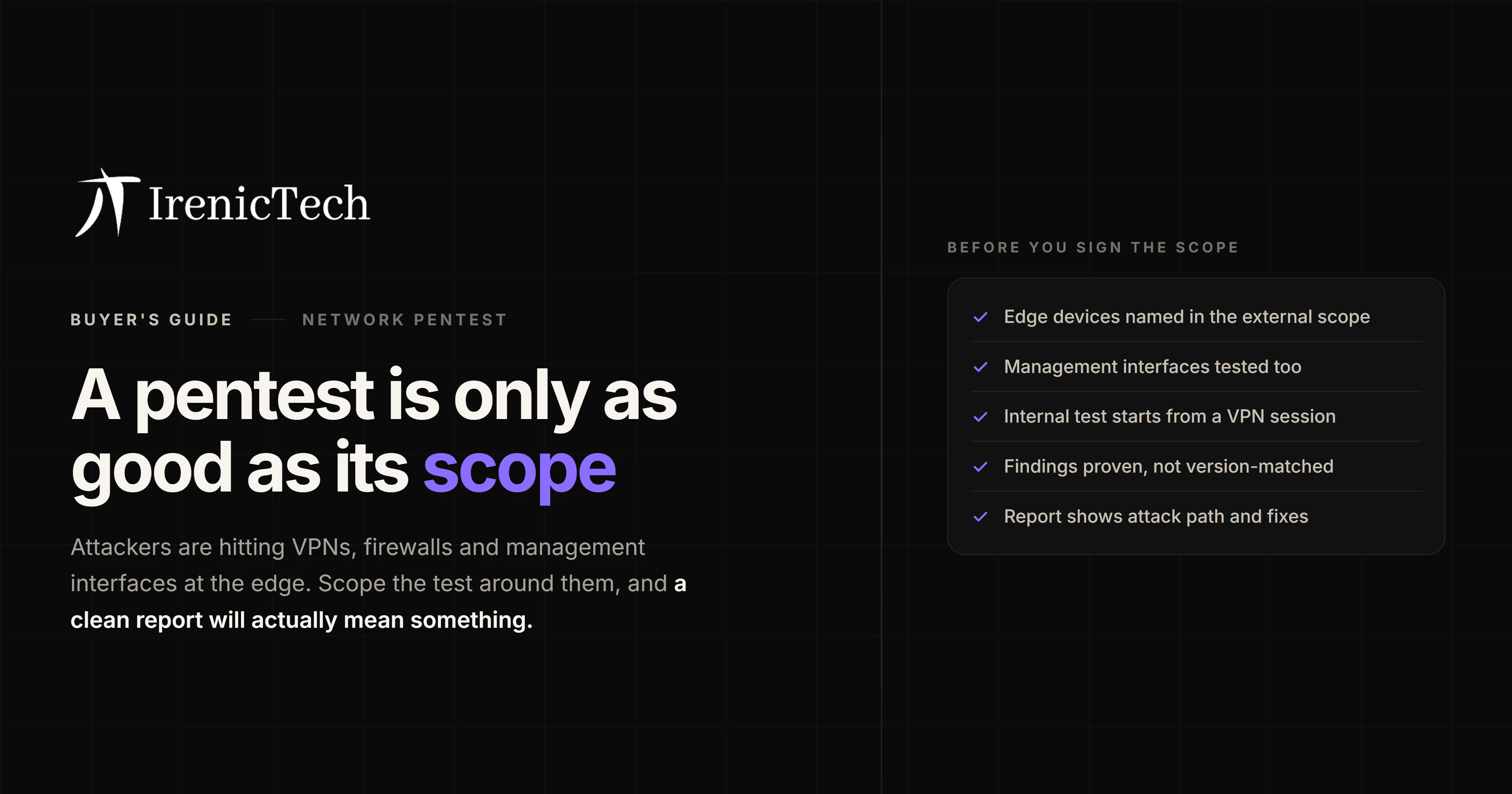
- Name the devices, not only the ranges. Give the tester your list of edge boxes with vendor and version. Time a tester spends rediscovering your VPN is time you paid for and did not get back.
- Put management interfaces in scope. Palo Alto says restricting who can reach the management interface reduces the risk of its October flaw, though the fix is to upgrade. Ask the tester to report, for each device, where its management interface can be reached from.
- Include the email gateway. Fortinet's, Cisco's and Barracuda's email security gateways were all listed in these weeks. They are edge devices, even if a different team runs them. If a vendor or provider hosts or runs yours, get their written permission before it goes in scope.
- Include the web servers on the same edge. They face the internet too, and our PHP2Shell post is a recent example of a flaw in one.
- Decide on availability testing in writing. Proving the Cisco ASA and FTD flaw means making the device reload, which takes it and the remote access it provides offline while it restarts. Most buyers will want the tester to confirm the version and exposure and report it, without triggering it. Write down which you want before testing starts.
What is an internal penetration test, and why start it from a VPN session?
An internal penetration test starts inside your perimeter and asks how far an attacker can get once they are in. NIST defines internal security testing as testing from inside the security perimeter. Organisations run one because the edge will fail at some point, through a stolen password, an unpatched appliance or a lost laptop, and the internal test measures what that failure costs.
The usual starting point is a desk on the office network. Our recommendation is different: start the internal test from a VPN session, logged in with a dedicated test account that has an ordinary remote user's access, and add a second start on an internet-facing host if the scope allows. This is our advice, not a requirement in any standard. Here is the reasoning.
- It is how attackers arrive. CISA's 2024 advisory on the Akira ransomware group, last revised in November 2025, says the actors sometimes got in through compromised VPN credentials. Where a VPN flaw lets someone in, the result is the same: someone on your network who should not be.
- The NCSC already thinks this way. Its guidance lists starting scenarios beyond an outsider with no access, among them a lost laptop, an unauthorised device plugged into the internal network and a compromised host in the DMZ.
- CISA's own red team has done this. In an assessment CISA published in August 2026, the defenders removed the red team's first foothold, so the team switched to an "assume breach" model and continued the assessment on that basis. CISA describes what its team did there; it does not tell organisations to copy it. The logic still holds for a buyer: the interesting question is what one foothold leads to.
- The VPN may be its own network. Remote users can land in an address range with its own firewall rules, and that range is what an attacker with stolen VPN credentials inherits. A test from an office desk never exercises those rules.
From that starting point, the internal test should try to reach other systems: the directory, file shares, backups and admin consoles. PTES calls this post exploitation and describes it as using a compromised machine to reach further into the client's infrastructure, which is lateral movement in practice. Our post on cloud security in 2026 covers why a working login has become an attacker's main tool.
How do you do network penetration testing, and what can a scanner not tell you?
A network penetration testing methodology runs in stages. PTES, the Penetration Testing Execution Standard, starts with pre-engagement interactions, where scope and permission are agreed, and its stages include vulnerability analysis, exploitation, post exploitation and reporting. PTES describes exploitation, which it also calls vulnerability confirmation, as actually triggering the vulnerabilities found earlier. That step is the difference between a test and a scan.
NIST defines vulnerability scanning as identifying hosts, their attributes and their associated vulnerabilities. The definition says nothing about proving anything. A scanner's output is a list of candidates, and four things stay out of its reach:
- Whether the version match is real. PTES warns that matching a reported version to known-vulnerable versions can produce false positives, so a tester should check the software really is what the banner or scanner says.
- Whether the flaw matters in your setup. A version match puts the PAN-OS or Fortinet flaw on the list. Whether either matters depends on who can reach the management interface or the CLI, which only a test of your network answers.
- Whether findings chain. NIST says most penetration tests look for combinations of weaknesses. A scanner scores each finding on its own.
- Whether someone is already in. Even a vendor's own tool can miss it. Rapid7, quoted by Help Net Security, says Volexity found that the Ivanti activity evades Ivanti's Integrity Checker Tool, and that a clean result does not rule out compromise.
A penetration test is not forensics either. If you see signs of an intrusion today, start with incident response, and test afterwards.
What should a network penetration test report contain?
A usable network penetration test report describes the scope, the attack path, the impact and a fix for each finding. That is what PTES asks the technical report to cover. The UK NCSC adds that the test team should judge how much risk each vulnerability poses to the organisation, so a finding comes with a judgement, not just a label.
The attack path is the part most often missing and most worth having. It shows the route from the starting point to the thing you care about, step by step, so you can see which single fix would have broken the chain.
Agree on scoring before the test. The NCSC says scoping should record reporting requirements, such as whether CVSS scores are included. FIRST's CVSS v4.0 specification says the Threat and Environmental metrics are optional but highly recommended for more meaningful results. In plain terms, ask for findings scored in your environment, not only the flaw's base score. A flaw behind a management interface nobody outside can reach is not the same risk as the same flaw facing the internet.
Two more things we would ask for, as our own advice: a flag on any finding that is on CISA's KEV catalog, so you know which ones attackers are already using, and a list of what was out of scope or could not be tested, so a clean result cannot be read as wider than it is.
What to do before you sign a network penetration test scope
The work that makes a network penetration test useful happens before the tester starts. This month:
- Write the edge inventory. Every VPN, firewall, email gateway, remote access portal and management interface, with vendor and version. Check each one against the KEV catalog now.
- Name every edge device in the external scope, management interfaces included, and ask for a report of where each interface can be reached from.
- Start the internal test from a VPN session with a dedicated test account that has an ordinary remote user's access, and add a compromised internet-facing host as a second starting point if the scope allows. Disable the test account when testing ends.
- Agree availability testing in writing. Say whether the tester may trigger flaws that crash or reload a device, or should confirm and report them only.
- Put the report contents in the contract: scope, attack path, impact and a fix for each finding, a risk rating, CVSS scored for your environment, and a KEV flag.
- Plan the retest. CISA recommends continually testing your security program in production against the attack techniques it documents. For a penetration test, keep each retest inside the written scope and permission you agreed. At minimum, retest the affected device when one you run appears on the KEV catalog.
Questions to ask a provider
- Who does the testing, and do they verify scanner findings by hand before they reach the report?
- How will you show the path from one host to the next, not just a list of findings?
- What happens if you find signs that someone is already inside?
- Is the retest included, and is the report reissued with each finding marked fixed or open?
- Does your report satisfy the body that asked for it, if that body requires an accredited firm?
Scope mistakes that make a clean report meaningless
- Leaving the VPN or firewall out because the vendor patches it.
- Excluding management interfaces, or testing them only from the inside.
- Running the internal test only from an office desk.
- Accepting a scanner export as the report.
- Reusing last year's address list without checking what has been added since.
- Testing systems a provider or host runs without asking who must give written permission. The Railway and Primcloud post explains why that permission matters.
Want a network test scoped around how attackers get in?
Our VAPT service includes a Network and Infrastructure engagement: "External first, internal when the scope calls for it." Targets, test windows and exclusions are agreed with you in writing before anything is touched, so the scope above is yours to set.
It covers discovery of the exposed hosts, ports and services across your address ranges, known vulnerabilities verified by hand rather than copied out of a scanner, and weak protocols, default credentials and paths from one host to the next. Every finding is scored with CVSS, the retest is free once you have fixed the findings, and you get a signed letter for the customer, auditor or regulator who asked. Destructive tests such as denial of service are never run unless you ask for them in writing.
The honest limits: we test networks, we do not run or monitor them, so the fixes stay with your team or your IT provider. We do not do red team exercises, social engineering or physical testing. If your regulator or customer requires an accredited firm, tell us on the scoping call and we will say plainly whether our report fits. If the test is for an audit, our security and compliance practice covers the compliance side.
Tell us what sits on your network edge and book a discovery call. We will tell you what we would put in scope first.
Part of our guide to AI security.
Sources: CISA's Known Exploited Vulnerabilities catalog, its catalog feed and its KEV alerts of 1 October, 4 October, 13 October, 14 October, 16 October, 29 October, 30 October, 6 November and 13 November 2026 (the listings), Palo Alto Networks' CVE-2026-0322 advisory, Cisco's ASA and FTD advisory, Fortinet's FG-IR-26-122, Help Net Security on the Ivanti flaws (reporting Volexity and Rapid7), NIST SP 800-115 and the NIST glossary entries for penetration testing, external and internal security testing and vulnerability scanning, the NCSC's penetration testing guidance, PTES on its structure, vulnerability analysis, post exploitation and reporting, CISA's red team assessment and Akira advisory, FIRST's CVSS v4.0 specification, 16 CFR 314.4 and 314.6 (the FTC Safeguards Rule), and Verizon's 2026 DBIR. Verified against these sources on 17 November 2026.
Frequently asked
What is network penetration testing?
Network penetration testing is a permitted exercise in which a tester imitates a real attacker against your network to find ways past its defences, then proves which of them work. NIST's long-standing definition, from its 2008 SP 800-115 testing guide, stresses combinations: most tests look for several weaknesses that together give more access than any one gives alone. A network penetration test usually has an external part, run from the internet, and an internal part, run from inside the perimeter.
What is the difference between internal and external network penetration testing?
External network penetration testing works from outside your security perimeter, as an attacker on the internet would, and covers whatever you expose: VPNs, firewalls, email gateways and their management interfaces. Internal network penetration testing works from inside the perimeter and measures how far someone who is already in can get. NIST draws the line between the two in exactly that place. Most buyers need both, because the external test shows how an attacker gets in and the internal test shows what happens next.
Why would an organization want to conduct an internal penetration test?
An organization conducts an internal penetration test because its perimeter will fail at some point, through a stolen VPN password, an exploited appliance or a lost laptop, and it needs to know what that failure would cost. CISA's 2024 Akira ransomware advisory says the group sometimes got in with compromised VPN credentials. An internal test shows whether one foothold leads on to the directory, the file shares and the backups, or stops where it landed. We recommend starting it from a VPN session, with a dedicated test account that has an ordinary user's access.
How do you do network penetration testing?
A network penetration test starts with scoping and written permission, which PTES, the Penetration Testing Execution Standard, calls pre-engagement interactions. The tester then maps the hosts and services in scope, checks them for known vulnerabilities, confirms which are real by exploiting them under the agreed rules, and tries to move from the first foothold to other systems. It ends with a report giving the scope, the attack path, the impact and a fix for each finding, and ideally a retest once you have fixed them.
Is a vulnerability scan the same as a network penetration test?
No. A vulnerability scan identifies hosts and the vulnerabilities associated with them, which is how NIST defines it, and stops there. A network penetration test takes those candidates and proves which ones an attacker could use. PTES warns that matching a reported software version against known-vulnerable versions can produce false positives, so a tester checks the software really is what the banner says. A scan also cannot show how findings combine, and combinations are what NIST says most penetration tests look for.
What should a network penetration test report include?
A network penetration test report should describe the scope, the attack path, the impact and a remediation step for each finding, which is what PTES asks the technical report to cover. The UK NCSC adds that the test team should judge how much risk each vulnerability poses to the organisation. Ask for CVSS scores that include the Threat and Environmental metrics, which FIRST's CVSS v4.0 specification highly recommends, so the severity reflects your network and not only the flaw in general.
Read us on Google
Make IrenicTech a preferred source.
Tell Google you want our work first. It takes one tap, and IrenicTech is favoured in your Top Stories, AI Mode, and AI Overviews whenever you search the topics we write about.
Add to preferred sources